
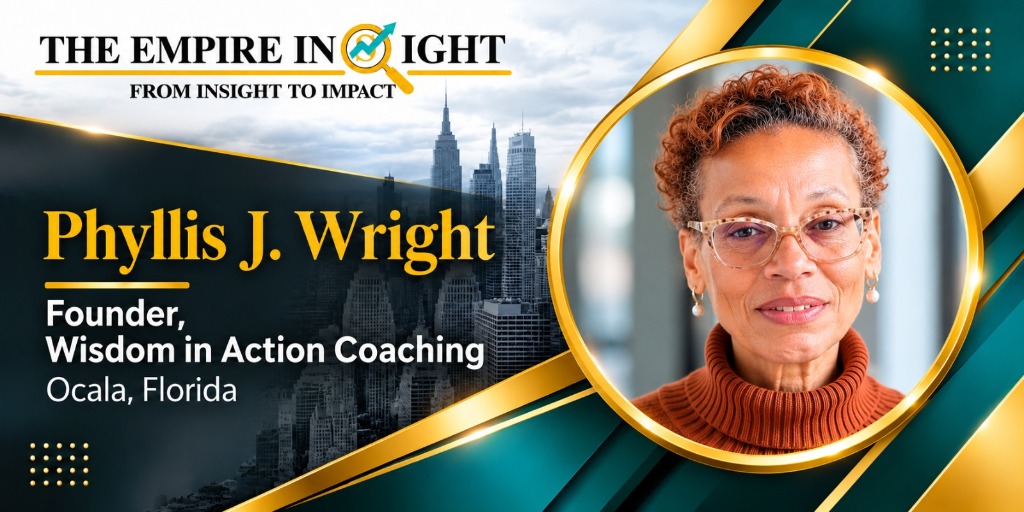
Most people are taught how to do the work. Very few are taught how advancement actually happens. For more than four decades, Phyllis J. Wright had a seat close to the decisions that shape national missions, and she watched, again and again, how talented professionals stalled while others quietly rose. Today, the first Black woman to serve as an Executive Director at the Office of Naval Intelligence (ONI) is turning that insider knowledge into a gift for others. From Ocala, Florida, she leads Wisdom in Action Coaching, where ambitious professionals learn the unwritten rules of career advancement that never make it into an employee handbook.
From 38 Years of Federal Service to a Purpose-Driven Coaching Practice
Phyllis J. Wright, PMP, spent 38 years as a federal employee. During her tenure at the Office of Naval Intelligence, she became the first Black woman to serve as an Executive Director and the highest-ranking Black woman in a civilian leadership role within the organization. She then spent nearly four more years as a consultant supporting the Department of Defense and the Intelligence Community, which gave her a rare view of leadership from both inside an organization and alongside its senior decision-makers.
Along the way she learned a lesson that no leadership book had taught her. Authority can establish responsibility, but trust determines how far your influence actually reaches. That single idea now shapes everything she does as a career coach, from the questions she asks her clients to the way she defines success.
“ Authority can establish responsibility, but trust determines how much influence you actually have. — Phyllis J. Wright, PMP, Founder of Wisdom in Action Coaching
What Four Decades Teach You About Trust, Power and Influence
Ask Wright what her career taught her about power, and she does not talk about rank. She talks about what people notice when a decision is difficult, when information is incomplete and when someone needs the truth delivered with respect. They remember whether you keep your word. They remember whether you share credit. In her view, power carries a responsibility to create conditions in which other people can contribute, and the most meaningful use of influence is helping people and the mission succeed together.
That perspective grew stronger during her years as a trusted senior advisor. She describes the moment people trust your judgment more than your title as a pattern rather than a single event. It shows up when leaders bring you into hard conversations because of your sound judgment, thoughtful questions and ability to help others see a situation clearly. Being trusted with a difficult conversation, she says, carries more meaning than being included because of a position. It means your contribution has become useful beyond the boundaries of your job description.
Representation Without Losing Yourself
Wright is candid about what it meant to lead as a Black woman in senior leadership at ONI. She understood that how she showed up could influence what others believed was possible, and she wanted her work to stand on its merits while recognizing that representation mattered to the people watching. The cost, as she describes it, was sustained preparation, discipline and the willingness to stay engaged in rooms where she might be one of very few people who looked like her.
She also had to decide how to pursue excellence without letting responsibility consume every part of her identity. Her conclusion shaped her whole leadership philosophy: leadership and authenticity can coexist. She approached representation as a duty to do her work well and stay attentive to the people coming behind her, while remembering that no single person can represent every experience within a community. Mentorship became the practical expression of that duty. Her faith and commitment to service kept the work grounded, and the legacy she cares about is simple: people who leave a conversation with her better prepared to pursue their own possibilities.
The Unwritten Rules of Career Advancement
The people who advance, Wright says, are rarely just the hardest workers. They understand how their work connects to what the organization needs, and they help others see that connection. Being capable matters, but so does communicating the value of that capability in language decision-makers recognize.
They also build purposeful relationships before they need an opportunity. They seek feedback, learn how decisions are made and develop a reputation for reliability and judgment. Most importantly, they understand the difference between a mentor who offers guidance and an advocate who can speak credibly about their readiness when they are not in the room. This is not about collecting influential contacts or becoming the loudest voice. It is about making a meaningful contribution, making sure that contribution is understood and earning the trust that lets others imagine you carrying greater responsibility.
A Hard-Earned Lesson: Give People a Heads-Up
One unwritten rule Wright learned the hard way involves reporting on colleagues’ performance. She was once asked to provide an update on her organization’s funding. Several offices were spending below their planned levels, and she reported that information as requested. What she failed to do was tell those colleagues their offices would be part of the update. She had focused on delivering the information and had not thought enough about how it would be received.
Because she valued those relationships, she took responsibility, apologized and promised to extend that courtesy going forward. The takeaway is one every professional can use. Accurate reporting and thoughtful communication go hand in hand. A heads-up gives colleagues time to prepare, add context and address concerns. It preserves accountability while showing respect, because trust depends on both the information you share and the care you take with the people affected by it.
“ Talent creates possibilities, but it does not automatically produce direction or action. — Phyllis J. Wright
The Question Every Ambitious Professional Should Prepare to Answer
Without referring to any confidential discussion, Wright says there is one question that quietly sits behind every promotion decision: can we trust this person with the next level of responsibility? Strong results help answer it, but decision-makers also look for evidence of judgment, discretion, collaboration and the ability to respond constructively under pressure.
Her practical advice is refreshingly direct. Ask your leader what would demonstrate readiness for the next level, and listen carefully to the answer. You deserve more than vague encouragement. Clear expectations let you develop intentionally and make an informed decision about your next move.
Why Brilliant People Stall and Others Rise
When asked for the single biggest difference between professionals who stall and those who rise, Wright points to something that has nothing to do with talent: the willingness to take ownership of growth. Someone can be highly capable and still wait for permission, avoid difficult feedback or assume that opportunities will arrive without a conversation.
Taking ownership means becoming curious about what is missing and acting on the answer. It might mean practicing a new skill, strengthening a relationship or asking for an assignment that stretches you. Wright is honest that organizational barriers are real and individual effort cannot remove every obstacle. Even so, understanding what you can influence gives you choices, and choices are where momentum begins.
Wisdom in Action Coaching: Where Experience Becomes Guidance
Retirement gave Wright the chance to decide how to use what she had learned. Mentoring had already become one of the most meaningful parts of her leadership journey, and watching people build confidence, accept greater responsibility and grow into leadership showed her where she wanted to keep contributing. Wisdom in Action Coaching was the result. She helps people live a life they would love, including a professional life that reflects their values and aspirations.
Her credentials back up the experience. Alongside her PMP designation, she trained through the Brave Thinking Institute as a Certified Life Mastery Coach and Certified Dream Builder Coach. Her mission is to make leadership wisdom more accessible, especially for people who have real ability and ambition but have not had consistent access to guidance or influential professional networks.
How She Coaches: Loosening the Belief That Being Stuck Means Something Is Wrong
The first thing Wright tries to undo in a client who feels stuck is the idea that a stalled career is a personal verdict. Thoughts like “I am not enough” or “I have missed my chance” can stop people from seeing the experience and strengths they already have.
Her process begins with three honest looks: what the person wants, what is happening now and what they have been telling themselves about the gap. From there, she helps identify practical needs, whether that means clearer goals, stronger communication, purposeful relationships or a different environment. Because she has been both the person receiving advice and the person giving it, she respects the vulnerability of asking for help. She does not hand out her own path as a prescription. She asks questions, listens for values, turns insight into a manageable action and helps clients learn from taking it, so progress continues long after the conversation ends.
“ Coaching should strengthen someone’s capacity to make decisions and lead themselves, so progress continues beyond our conversations. — Phyllis J. Wright
The Advice She Wishes Someone Had Given Her Earlier
If a senior leader had pulled her aside early in her career, Wright says she would have welcomed this: be as intentional about your own development as you are about delivering for everyone else. Learn to explain what you contribute and what you hope to do next, and ask questions early enough for the answers to shape your choices.
She would also tell her younger self to build relationships rooted in mutual respect, to seek advocates as well as mentors and to avoid treating every “no” as permanent. Sometimes a no means more preparation is needed, and sometimes it means the opportunity is elsewhere. Discernment helps you tell the difference. Above all, she says, do not postpone building a meaningful life until you reach a particular title. Your well-being, relationships and sense of purpose deserve attention throughout the journey.
Purpose in Practice: College to Career and a Scholarship Vision
For Wright, purpose is not abstract. It becomes visible in the decisions people make and the commitments they keep, such as applying for a role they have been avoiding, setting a healthier boundary or using a skill to serve a community.
In her own life, that means developing a College to Career signature program built around The Unwritten Rules. Her vision is to partner with colleges, universities and supporting organizations so more students can enter the workplace with insight into professional relationships, expectations and advancement. She also aspires to establish a scholarship endowment at North Carolina A&T State University. These are goals she is actively working toward, and she is clear that planning, partnerships and consistent action will be needed to bring them to life.
A Message to the Woman Who First Walked Into Federal Service
Asked what she would tell her younger self, Wright answers with warmth. The experience she is gathering will serve a purpose beyond any one job, and the lessons, relationships and difficult decisions will become wisdom she can share. She does not need to see the entire path to take the next step with integrity. Stay teachable, protect your faith, make room for joy and notice the people whose potential needs encouragement. A later chapter can be expansive and deeply meaningful, because there is still a life to imagine and work worth doing beyond the career you first set out to build.
Key Takeaways for Professionals Who Want to Advance
Wright’s message is clear and practical. Take ownership of your growth. Start the honest conversation about your future. Build trust through judgment, discretion and respect. Seek advocates as well as mentors. And never wait for a title to begin building a life you would love.
Core Insights • Phyllis J. Wright, PMP
“Authority can establish responsibility, but trust determines how much influence you actually have.”
“Talent creates possibilities, but it does not automatically produce direction or action.”
“Do not postpone building a meaningful life until you reach a particular title.”
Phyllis J. Wright, PMP
Founder & Executive Career Coach | Wisdom in Action Coaching Ocala, Florida, USAGuiding Creed: “Coaching should strengthen someone’s capacity to make decisions and lead themselves, so progress continues beyond our conversations.”
Connect with Phyllis: www.wisdominactioncoaching.net/home • phyllis@wisdominactioncoaching.com